Best Muslim Matrimony site that helps you to find your exact match partner with our large community. You can register and explore for free.
Best Muslim Matrimony site that helps you to find your exact match partner with our large community. You can register and explore for free.
 23, Oct 2026
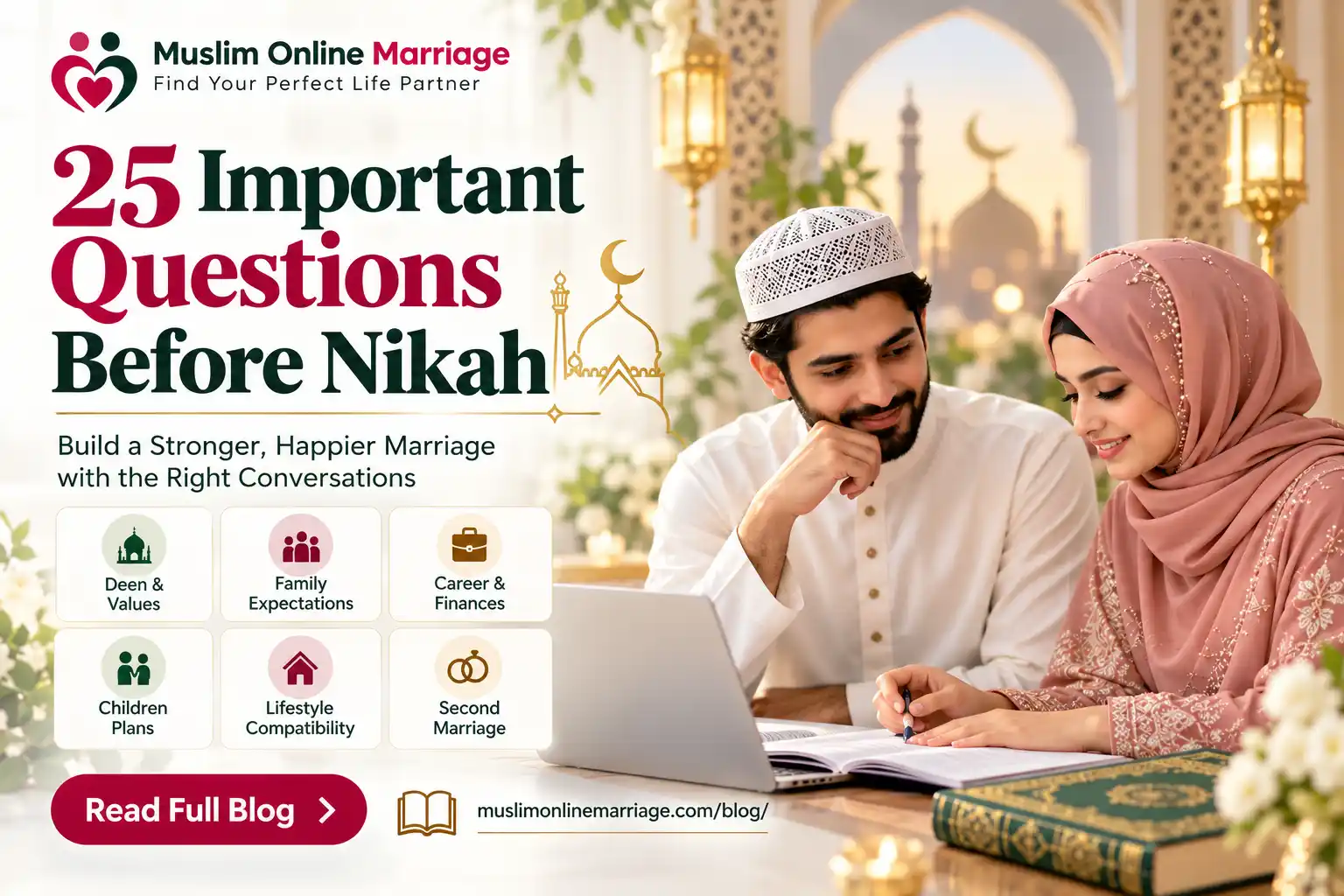
Choosing the right life partner for a Muslim marriage should not be based only on appearance, education, salary, or family status. Before Nikah, meaningful conversations can help both individuals understand whether their values, lifestyle, family expectations, and future plans are truly compatible.
Sometimes a matrimonial profile looks perfect and both families are comfortable with the match, but later the couple discovers major differences regarding career, living arrangements, finances, children, or family responsibilities.
That is why Muslim matrimonial search should focus not only on a profile match, but also on life compatibility.
If you are searching for a suitable Muslim bride or groom, you can begin your matrimonial journey with Muslim Online Marriage.
This article provides practical matrimonial guidance. For specific Islamic rulings or personal religious matters, it is advisable to consult a qualified Islamic scholar.
Marriage connects two people through everyday life, responsibilities, finances, family relationships, and long-term plans.
Before marriage, it is important to understand whether you simply like each other or whether you can realistically build a life together.
Compatibility does not mean agreeing on everything.
What matters is understanding where your differences are, how significant they are, and whether both partners can handle those differences with respect and healthy communication.
Religious expectations can be important for many Muslim individuals and families.
However, words such as “religious” or “practising” may mean different things to different people.
Try to understand respectfully how the potential spouse approaches their religious life.
You may ask:
How important are your daily religious practices to you?
It is also useful to understand what kind of religious environment they expect within their future household.
Different approaches do not automatically mean that a marriage cannot work, but important differences should be understood before Nikah.
Parents and extended family often play an important role in Muslim marriages.
One useful question to ask is:
How do you see family involvement after marriage?
Some couples prefer living with a joint family, while others prefer a nuclear family setup. Others may remain flexible depending on circumstances.
You should also discuss responsibilities toward parents.
Caring for parents may be important to both partners, but each person should understand what those responsibilities will practically involve.
This may appear to be a simple question, but it can become an important issue after marriage.
Ask your potential spouse:
Which city or country do you plan to live in after marriage?
If both partners work in different cities, discuss whether one person would relocate or whether a long-distance arrangement would be necessary for some time.
If you are searching for location-specific matches, you can explore Indore Muslim Matrimony Profiles.
However, do not make assumptions based only on the location mentioned in a matrimonial profile. Discuss future relocation plans directly.
Career decisions can significantly affect married life.
It is useful to understand:
Do both partners want to continue working after marriage?
If career plans may change after having children, discuss that possibility as well.
Work schedules, transfers, international opportunities, business plans, and career ambitions can all influence future family life.
Neither partner's career should automatically be treated as less important. Expectations should be discussed before marriage.
Discussing money may feel uncomfortable, but basic financial transparency before marriage can prevent misunderstandings later.
Knowing someone's salary alone is not enough.
It is more useful to understand:
How they approach savings
Their spending habits
Whether they have significant loans
Financial responsibilities toward parents
Long-term financial goals
You might ask:
How would you like to manage household expenses and savings after marriage?
If either person has significant debt or financial responsibilities, these should be discussed honestly at an appropriate stage.
Expectations regarding children are important to discuss before marriage.
Ask:
Would you like to have children in the future?
You can also discuss parenting values, education preferences, and how much involvement extended family may have.
You do not need to decide every detail before marriage, but understanding each other's general expectations can be valuable.
Two people can both be good individuals while having very different lifestyles.
Daily routines, social life, travel, food habits, work-life balance, and spending patterns can affect married life.
For example, one person may enjoy a highly social lifestyle while another may prefer privacy and quiet family time.
A useful question is:
What does a normal weekend or family day look like for you?
Simple questions like this can reveal a lot about lifestyle compatibility.
People handle disagreements differently.
Some prefer discussing problems immediately, while others need time before talking.
Ask your potential spouse:
How do you usually handle disagreements when you are upset?
You can also discuss whether serious disagreements should remain between the couple initially or whether family members should become involved.
Disagreements are normal in relationships. Disrespectful communication is a much bigger concern.
Privacy does not mean secrecy.
Expectations concerning personal space, friendships, phone privacy, social media, and extended-family boundaries may differ between individuals.
Ask:
How do you view privacy and personal boundaries within marriage?
Discussing this early can help build trust and reduce misunderstandings later.
Important information that could significantly affect married life should not be intentionally hidden before marriage.
Health-related discussions should be handled respectfully and privately.
Personal medical details do not necessarily need to appear publicly on a matrimonial profile.
However, when a relationship becomes serious, relevant health information may need to be discussed appropriately so that both individuals can make informed decisions.
Transparency becomes especially important for divorcees, widows, and widowers considering remarriage.
There is no need to discuss unnecessary private details about a previous relationship, but current responsibilities should be clear.
These may include:
Children
Custody arrangements
Financial obligations
Ongoing family responsibilities
Future expectations
If you are searching for a suitable match after divorce, explore Divorcee Muslim Matrimony Profiles.
For remarriage opportunities, you can also explore Muslim Second Marriage Matrimony.
People entering a second marriage often bring more life experience and existing responsibilities into the relationship.
Expectations may therefore be different from those of a first marriage.
If children are involved, discuss what role the future spouse would be expected to play.
Also discuss how responsibilities connected to the previous family will continue after remarriage.
You may ask:
How do you see balancing a new marriage with your existing family responsibilities?
Such conversations may feel difficult, but clarity before marriage is usually better than misunderstandings later.
Initial communication between potential matches can help both people understand basic compatibility.
However, when discussions become serious, involving families at an appropriate stage can be useful.
Family involvement may help with verification, understanding expectations, and discussing practical responsibilities.
At the same time, family compatibility alone is not enough.
The consent, comfort, and willingness of the two individuals entering the marriage should remain central.
Online matrimonial platforms help people connect, but users and families should independently verify important information before making marriage decisions.
When a match becomes serious, appropriately verify details such as:
Education
Employment
Marital status
Family background
Avoid sharing sensitive documents such as Aadhaar, PAN, banking information, or financial credentials during the early stages.
Be especially cautious if someone quickly asks for money, repeatedly changes personal information, or avoids basic verification.
Do not ignore warning signs simply because you like someone or want to finalise marriage quickly.
Important concerns may include a person who:
Hides their marital status
Provides contradictory information
Consistently avoids introducing family
Requests financial help
Refuses reasonable verification
Creates unreasonable pressure to marry quickly
Even a genuine matrimonial profile cannot guarantee complete compatibility.
Take enough time for communication and verification before making a final decision.
What values are most important to you in marriage?
What are your religious practices and expectations?
Where do you plan to live after marriage?
Do you prefer a joint family or nuclear family setup?
How should responsibilities toward parents be managed?
What are your long-term career goals?
Do both partners plan to continue working after marriage?
How would you like to manage household expenses?
What are your savings and long-term financial goals?
Do you have any significant loans or financial obligations?
Do you want children in the future?
What are your views on parenting and education?
What does a healthy work-life balance look like to you?
How do you usually handle disagreements?
When upset, do you prefer space or immediate discussion?
How involved should families be in disagreements between spouses?
How do you view personal privacy and boundaries?
What are your expectations regarding social media?
How should friendships and social life be managed after marriage?
How flexible are you about relocating?
Is there any important health information that should be discussed before marriage?
Are there any ongoing responsibilities from a previous engagement or marriage?
In a second marriage, how should responsibilities toward children and existing family be managed?
Where do you see your life in the next five years?
What does a successful marriage mean to you?
These questions do not need to be asked like an interview during one meeting.
It is usually better to discuss them naturally over several respectful conversations.
A detailed matrimonial profile can help both individuals understand initial compatibility.
Along with age, education, and location, include thoughtful information about:
Partner expectations
Lifestyle
Family background
Career
Future plans
You can begin your search by exploring Muslim Online Marriage – Muslim Matrimonial Profiles.
The clearer your profile is, the easier it may be to avoid unnecessary mismatches.
The right match does not mean finding someone with whom you have absolutely no differences.
A better match may be one where both people understand their important differences and can discuss them honestly and respectfully.
Review the profile carefully, ask meaningful questions, involve families at the right stage, verify important information, and take enough time before making a final decision.
Marriage is not only about the wedding day.
It is a partnership involving everyday life, family, responsibilities, finances, communication, and long-term goals.
If you are searching for a Muslim bride or groom for yourself or a family member, begin by understanding your own priorities.
Create a complete matrimonial profile and explore suitable matches according to your preferences.
Create your profile on Muslim Online Marriage and explore matrimonial profiles by location, community, and partner preferences.
For remarriage after divorce, explore Divorcee Muslim Matrimony.
For second-marriage matches, visit Muslim Second Marriage Matrimony.
For matches in and around Indore, explore Indore Muslim Matrimony.
Muslim Online Marriage — The Beginning of the Right Match and a Beautiful Nikah.

If you are searching for HIV Positive Matrimony then log on to or visit HIV Parichay Matrimony World's No.1 Matrimony for hiv positive in whole India.
If you are searching for Normal Indian Matrimony profiles then log on to or visit- Parichay Matrimony Pvt Ltd India's leading and trusted marriage bureau matrimony for all castes all over the world.

Blog & Articles
Free support: +917869419703 | info@muslimonlinemarriage.com
HELP & SUPPORT
SOCIAL MEDIA





**Muslim Online Marriage – Trusted Muslim Matrimony & Marriage Bureau in India.** Find compatible Muslim Brides & Grooms for Nikah, First Marriage and Second Marriage. Create Your Free Matrimonial Profile Today! Create Free Account
Copyright © 2026 Muslim Marriage All rights reserved.